

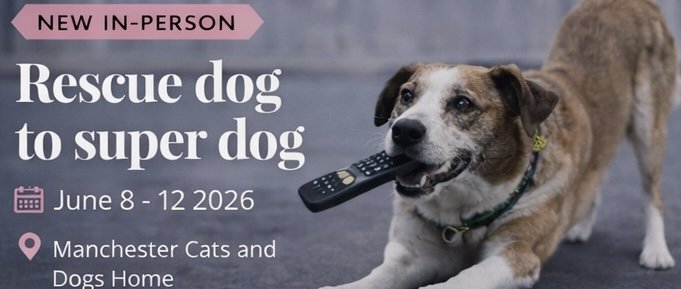
Rescue Dog to Super Dog
Support, Service & Working Potential in Rescue Dogs
This five-day practical programme explores how rescue dogs may be suitable for support, assistance, or working roles, and how those roles can be identified, trained, and ethically bounded within rescue settings.
The course is not about turning every dog into a “super dog”. Instead, it focuses on structured assessment, realistic role matching, foundation training, and welfare-led decision-making. Participants learn how to identify genuine potential, how to develop it responsibly, and how to avoid inappropriate pressure or misplaced expectations.
Delivered entirely within operational rescue environments, all work takes place with centre dogs and fits around normal kennel and adoption routines. The programme reflects the realities of rescue work, including varying handling skill levels, time constraints, and the need for outcomes that support both dogs and organisations.
What the programme covers
Across five days, participants will learn how to:
Assess dogs for support, assistance, or working suitability
Distinguish between support/service roles and scent-based working roles
Identify appropriate mitigating tasks or detection-style roles
Train core foundation skills common to “super dog” work
Use simple metrics to track training progress and suitability
Understand welfare limits, ethical boundaries, and duty of care
Explore how training can support enrichment, confidence, bonding, and rehoming success
Programme structure
Day 1 – Role Assessment & Allocation
Participants are divided into two role pathways: support/service dog case studies and detection dog roles (e.g. drugs, explosives, public search). Handlers pair across roles and assess how a dog could mitigate a disability or fulfil a detection function. Key differences between support dogs and working scent dogs are explored. Dogs are shortlisted, with one “golden ticket” available per handler. Final dog allocation is determined through assessment, draw, and selection rounds.
Day 2 – Foundation Super Skills
Six core foundation skills are introduced: nose target, paw target, hold, push, pull, and chin target. Support dogs begin task-linked skill development. Scent dogs begin first-stage indication work. Handling approaches and training plans are reviewed and adjusted.
Day 3 – Progression & Metrics
Training continues with emphasis on repetition, clear criteria, and reward placement. Scent dogs progress to the next stage of indication work. Training plans are reviewed using simple metrics to support long-term progression and suitability decisions.
Day 4 – Strengthening & Welfare
Behaviours are strengthened through increased speed, resistance, and task demand. Additional foundation behaviours may be introduced. The day also covers kit use, professional boundaries, welfare considerations, duty of care, and mental health within the industry.
Day 5 – Integration & Media
Training chains are linked under cue. Foundation sequences are filmed regardless of stage achieved. The role of training in welfare, bonding, enrichment, and rehoming success is explored, alongside discussion of physical, mental, and olfactory enrichment.
Practical details
Audience: Mixed rescue staff and professional trainers
Location: Manchester Dog Home
Typical hours: 10:00–16:00 (flexible)
Cost: £990 for non members and £800 for members
This programme is designed for professionals who want to explore working potential responsibly, without compromising welfare or realism.