

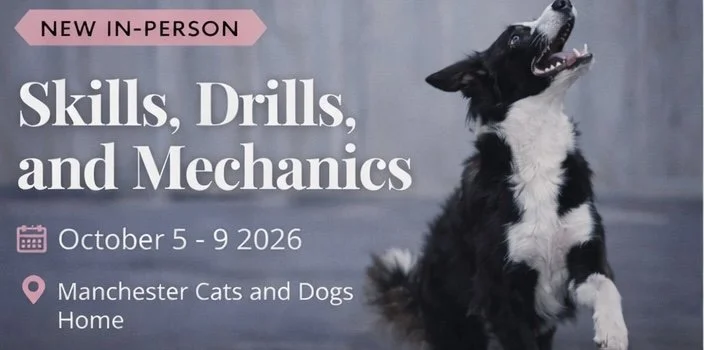
Skills, Drills & How Dogs Learn
Core Training Mechanics for Real-World Behaviour Change
This five-day practical programme is designed for professionals who want to improve outcomes for dogs by improving how training is actually delivered. The focus is not on exercises or tricks, but on mechanics: how dogs learn, how information is communicated, and how clarity, timing, and structure influence welfare and reliability.
Delivered inside public-facing adoption kennels, the programme reflects the realities of rescue and rehoming environments. All work is conducted with centre dogs and fits around normal kennel routines, ensuring that learning transfers directly into day-to-day practice.
The course emphasises that small improvements in training mechanics — marker timing, reward placement, criteria setting, and progression — can produce significant gains in learning speed, emotional stability, and behaviour reliability.
What the programme covers
Across five days, participants will learn how to:
Design outcome-led training plans based on clear end goals
Use luring, shaping, and capturing effectively and appropriately
Apply markers and reinforcement with precision and consistency
Build behaviours through clarity, repetition, and play-based reinforcement
Track progress using simple, meaningful metrics
Proof behaviours for real-life, public-facing environments
Improve handler confidence and consistency across teams
Programme structure
Day 1 – Outcome-Based Training
Participants work backwards from clearly defined goal behaviours. The focus is on classical conditioning, clean environmental set-ups, and effective luring strategies. Dogs are paired in advance to ensure suitability and welfare.
Day 2 – Shaping & Marking
Operant conditioning principles are explored in depth. Marker timing, shaping plans, and reinforcement strategies are introduced. Participants practise building behaviours through repetition, clarity, and play-based learning.
Day 3 – Capturing, Reward Placement & Merging
Participants learn how luring, shaping, and capturing are combined in real training plans. Emphasis is placed on reward placement, maintaining clarity, and smoothly merging techniques without confusing the dog.
Day 4 – Metrics for Progress
Introduction to Push / Drop / Stick models. Participants learn how to adjust criteria efficiently, identify plateaus, and maintain welfare while progressing behaviours.
Day 5 – Proofing: The 3 Ds + B
Training is generalised using distraction, distance, duration, and boredom. Participants learn how to build reliability and resilience without overfacing dogs or undermining learning.
Practical details
Audience: Mixed rescue staff and external trainers
Location: Manchester Dogs Home
Typical hours: 10:00–16:00 (flexible)
Cost: £990 for non members and £800 for members
This programme is for professionals who want cleaner mechanics, clearer communication, and training that genuinely improves welfare and real-world outcomes.