

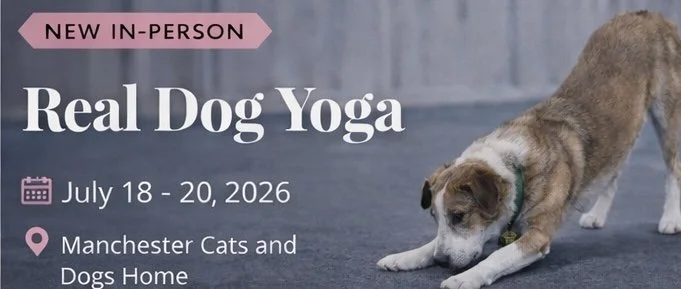
Dog Yoga
Choice-Based Handling & Stress Reduction Protocol
This five-day practical programme teaches a clear, structured, choice-based handling protocol for dogs experiencing shutdown, fear, or chronic stress. The focus is on safety, predictability, and emotional regulation, rather than compliance or performance.
Dog Yoga is designed for professionals who need dogs to feel safe enough to engage — whether for assessment, handling, daily care, or behaviour work. It is particularly relevant for dogs who struggle with proximity, handling, confinement, novelty, or repeated exposure to stressors within rescue and rehoming environments.
All work is delivered inside operational rescue settings, including kennels, interview rooms, and staff areas. The programme fits around normal kennel and adoption routines and is suitable for mixed teams of staff and trainers with varying experience levels.
What the programme covers
Across five days, participants will learn how to:
Identify stress signals, avoidance behaviours, and safety-seeking strategies
Understand the role of choice, control, and pace in stress reduction
Use a mat-based protocol to support emotional regulation
Apply start, stop, and pause behaviours to create predictability
Measure stress and engagement using observable, repeatable metrics
Integrate the protocol into daily handling, husbandry, and trigger exposure
Maintain clarity and welfare across multiple handlers
Programme structure
Day 1 – Stress, Choice & Assessment
The role of choice, control, and training pace in stress reduction is explored. Triggers, symptoms, and underlying drivers of stress are discussed alongside attachment and safety. Case-study dogs are pre-selected with kennel staff, focusing on shutdown, fearful, or highly stressed dogs. Each dog is assessed individually using structured observation and note-taking.
Day 2 – The Mat Protocol
Introduction to the mat protocol, including start, stop, and pause behaviours. Predictability, patterning, and movement are used to support safety. Safety-seeking behaviour, session set-up, motivation, and reinforcement delivery are covered, alongside how micro-behaviours influence emotional regulation.
Day 3 – Criteria & Metrics
Refining criteria and measuring changes in anxiety and engagement. Training is framed as a choice, not a demand. Focus on handler mechanics, body position, and timing, with clear decision-making around when to wait and when to prompt.
Day 4 – Trigger Integration
Applying the protocol to real-world triggers using scent, movement, and handling patterns. Participants develop repeatable routines and practise alternating handlers to maintain clarity, consistency, and welfare.
Day 5 – Review & Forward Planning
Progress is assessed and case studies are shared. Participants write practical plans to continue the work beyond the course. Reflection focuses on spotting skills, handler confidence, and application within everyday rescue environments.
Practical details
Audience: Usually mixed rescue staff and professional trainers
Location: Kennels, interview rooms, and staff areas
Typical hours: 10:00–16:00 (flexible)
Cost: £990 non members and £800 for Academy Members
This programme is designed for professionals who want a calm, ethical, and repeatable way to support stressed dogs without escalating pressure or risk.